Student budget: a simple plan that actually holds
A student budget holds when it starts from what really comes in, pays the fixed costs first, gives food and going out a weekly number, keeps subscriptions small and leaves a buffer for surprises. Ten minutes a week is enough to keep it on track.
Why student budgets break
Student money has a shape of its own. Some of it arrives in lumps, some depends on how many hours you worked, and a lot of it goes out in small amounts that are easy to forget: a coffee between classes, a round of drinks, a book you needed by Monday. Most budgets don't fail because of one big mistake. They fail because the plan was made for a steady salary and a tidy month, and student life is neither.
The answer is not a stricter budget. It is a simpler one, built in the right order.
Start with what actually comes in
Write down every source of money you can count on, and how often it arrives. For most students it is some mix of:
- Help from family, regular or now and then.
- A part-time or summer job, where pay can change with your hours.
- Grants, scholarships or student aid, paid on their own schedule, sometimes once per term.
Two habits make this step reliable. First, when an amount varies, plan on the lower end of what you usually get; a good month then becomes a bonus instead of a hole in the next one. Second, turn lump sums into a monthly figure. If a payment arrives once a term, divide it by the months it has to cover: if $1,200 lands at the start of a four-month term, that is $300 a month, not $1,200 to spend in September.
Pay the fixed costs first
Fixed costs are the ones that arrive whatever you do: rent or your share of it, a phone plan, a transport pass, insurance, internet. List them with their due dates and subtract them from your monthly income before anything else. What is left is the money you actually get to decide about.
The order matters. If rent comes out of whatever is left after the fun, one expensive weekend can make it late. If it comes out first, the weekend simply gets smaller.
Food and going out: think in weeks
Food is usually the biggest flexible cost, and the one that drifts most. A monthly number is hard to feel on the 9th; a weekly number is easy. If your food budget is $260 a month, that is about $60 a week. Groceries, the campus cafeteria and takeout all count against it.
Going out works the same way. Give it a number you are happy with rather than a ban you will break. A fixed amount for fun makes each choice clear: this concert or two nights out, not both and then instant noodles until the end of the month.
A few habits help without making life grim: a short list before you shop, a couple of meals you can cook in bulk, and a quick look at what is left for the week before you say yes to plans.
Keep subscriptions small
Music, streaming, cloud storage, a gym, an app you tried once: each costs a few dollars, which is exactly why they pile up. Once a term, list them and ask of each one whether you used it this month. Look for student pricing where it exists, and share a plan when its terms allow it. Our article on how to find and cut your subscriptions goes through this step by step.
Leave a buffer for surprises
Something always comes up: a lab fee, a train ticket home, a cracked phone screen, a friend's birthday. A budget with no room for these breaks the first time one happens. Set aside a small fixed amount every month as a buffer. If it is not used, let it build up; over a year it becomes a real cushion. When it is used, that is exactly what it was for.
A worked example
Say $1,100 a month comes in, from all sources combined, once lump sums are spread over the months they cover. Here is one way it could be split:
| Item | Per month |
|---|---|
| Rent (your share) | $550 |
| Phone plan | $20 |
| Transport pass | $40 |
| Fixed costs | $610 |
| Food (about $60 a week) | $260 |
| Going out | $80 |
| Subscriptions | $15 |
| Books, supplies and other | $75 |
| Buffer for surprises | $60 |
| Total | $1,100 |
Fixed costs take $610, which leaves $490 to plan. Food, going out, subscriptions and supplies use $430 of it, and the last $60 goes to the buffer. Every dollar has a job, and none of them is rent money in disguise. Your own numbers will look different; the order is what carries over.
If you would like a reference point, the 50/30/20 rule is a common starting split. Rent can take a big share of a student income on its own, though, so use it as a comparison rather than a target.
A simple weekly routine
Budgets hold because of small, regular check-ins, not because of a perfect plan made in September. Pick a moment, say Sunday evening, and spend ten minutes on this:
- Add anything you paid in cash or forgot to note during the week.
- Look at what is left for food and going out, and decide on the week ahead.
- Check which bills are due in the next seven days.
- If a category ran over, take the difference from another one or from the buffer, on purpose.
At the end of the month, adjust the numbers that turned out to be unrealistic. A budget you change is better than a budget you abandon. For the full method, month after month, see how to make a monthly budget.
How Fince can help
Fince is a budget tracker for iPhone that asks for no bank login and no account. You note what you spend, and it shows where the month stands. For a student budget, a few parts are especially useful:
- Monthly budgets per category, such as Food & Drinks, Entertainment and Subscriptions, with progress bars and alerts at 80% and 100%. The free version includes up to 10 budgets, which is plenty for the plan above. The monthly budgets guide shows how to set them up.
- Quick add: type "coffee 4.50" and Fince fills in the category and the amount, so noting small spending takes seconds.
- Recurring bills for rent and your phone plan, with a notification the day before each one; bills due in the next seven days show under Upcoming on the dashboard.
- Left to spend per day on the dashboard: what this month's income leaves after your expenses and the bills still due, plus any recurring income still expected, divided by the days left, including today.
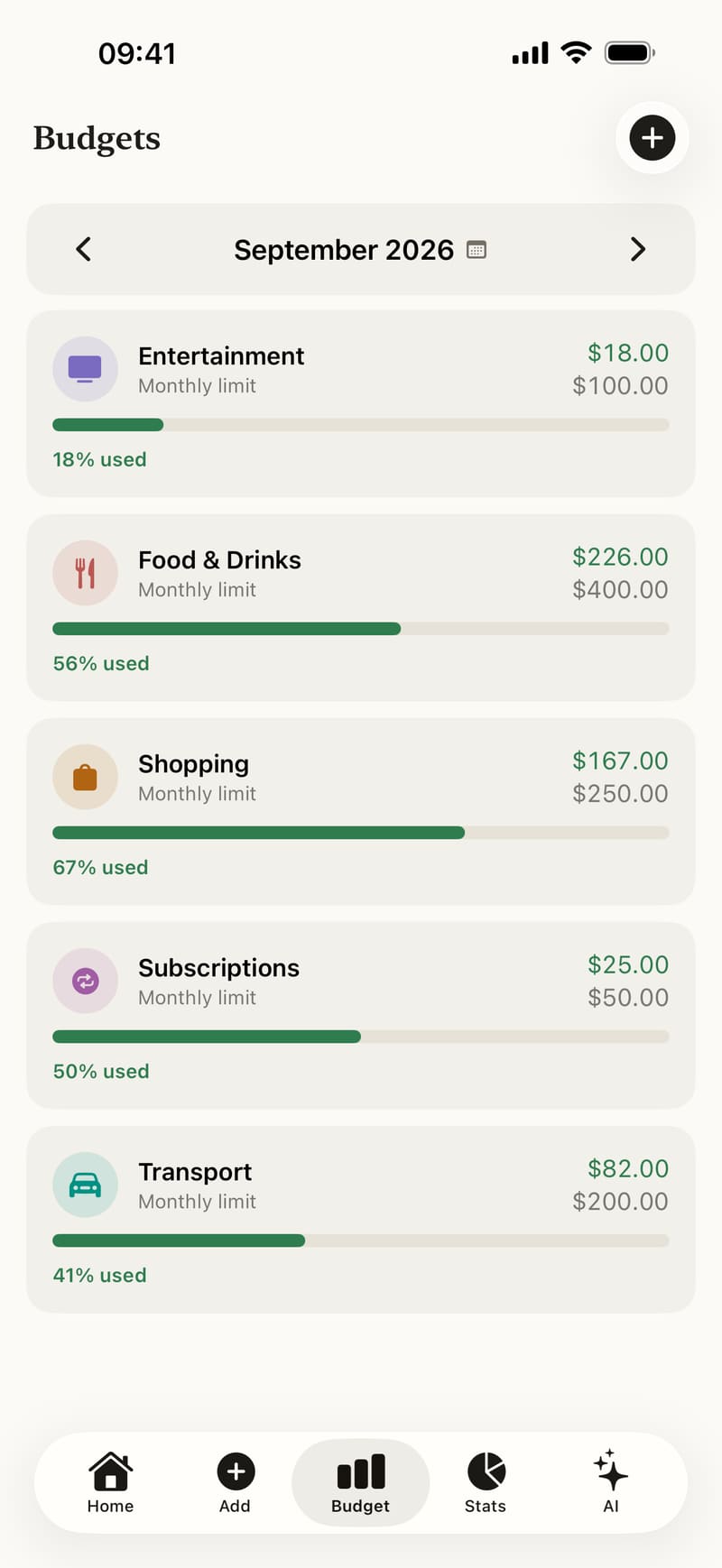
To be clear about the limits: Fince does not connect to your bank, so the picture is only as complete as what you enter. For many people, that small moment of typing an expense is also what makes the budget stick.