How to make a monthly budget, step by step
A monthly budget is a plan for one month of money, written before the month starts. It takes five steps: write down the income you can count on, list your fixed bills, set your savings aside first, share what remains between a few everyday categories, and review it all at the end of the month. The first month is a draft; each review makes the next one more accurate.
Budgets have a reputation for being a diet for your wallet: strict, joyless, dropped by the third week. They don't have to be. At its simplest, a monthly budget answers one question before the month begins: where is this month's money going to go? Once the answer is written down, everyday decisions get easier, because you're no longer guessing.
The method below works on paper, in a spreadsheet or in an app. All you need is a recent bank statement or two and a quiet moment.
Step 1: Write down the income you can count on
Start with what actually lands in your account each month: your take-home pay after tax and deductions, not the gross figure on your contract. Add any other regular income, such as a second job, benefits, support payments or rent from a lodger.
If your income changes from month to month (freelance work, tips, commissions, seasonal jobs), don't build the budget on your best month. Use a cautious figure, such as the lowest of your recent months, and treat anything above it as a bonus to set aside once it has actually arrived.
Step 2: List your fixed bills
Fixed bills are the amounts that leave every month whatever you do: rent or mortgage, energy and water, internet and phone, insurance, loan repayments, subscriptions, a transport pass. Go through a recent statement line by line. Subscriptions in particular are easy to miss, because they're small and taken automatically.
Some bills don't come monthly: a yearly insurance premium, a car service, a membership fee. Divide each one by twelve and add that monthly share to your list. A $240 yearly bill becomes $20 a month. If you set that amount aside every month, the bill is no longer a surprise when it arrives.
Step 3: Pay yourself first
If you save whatever is left at the end of the month, there is often nothing left. Flip the order: decide on a savings amount now, before you plan any everyday spending, and move it to a separate account as soon as your income arrives.
The right amount depends on your situation, and it doesn't need to be large to be useful. A small, regular amount you actually keep does more than an ambitious one you take back after ten days. If you're building a safety cushion or saving for something specific, give it a target and a date, so the monthly amount has a reason behind it.
Step 4: Share out what remains
Now do the subtraction: income, minus fixed bills, minus savings. What's left is the money for everyday life, the variable spending that changes from week to week: groceries, eating out, fuel, clothes, going out, gifts, personal care.
Split that amount into a handful of categories. Five to eight is plenty; with twenty, you'll spend more time sorting than living. Base each limit on what you really spent in recent months, then trim where you want something to change. Keep a small buffer line for what you can't predict, because there is always something.
If you'd like ready-made proportions, the 50/30/20 rule offers a starting split between needs, wants and savings. If you'd rather not juggle categories at all, you can turn the whole amount into a single figure per day, as explained in How much can I spend per day?
A worked example
Say your take-home pay is $3,000 a month. Here's how the plan might look.
| Line | Per month |
|---|---|
| Take-home pay | $3,000 |
| Fixed bills: rent $1,050, energy and water $120, phone and internet $75, insurance $90, subscriptions $35, transport pass $30 | −$1,400 |
| Savings, moved on payday | −$300 |
| Left for everyday spending | $1,300 |
The $1,300 is then shared out: groceries $500, eating out $200, shopping $200, going out $150, personal care $100 and a $150 buffer. That adds up to exactly $1,300. Over a 30-day month, it comes to about $43 a day for everything that isn't a bill.
Notice how much smaller the everyday amount is than the paycheck. That's the point of the exercise: $3,000 feels like a lot on payday, while $43 a day is what you really have to live on once the bills and savings are covered.
Step 5: Review at the end of the month
This is the easiest step to skip, and it's the one that makes a budget work. At the end of the month, put your plan next to what you really spent, category by category, and ask yourself three questions:
- Where did I go over, and why? A one-off (a wedding gift, a broken phone) is different from a pattern (lunch out every weekday).
- Was the limit realistic? If you go over the same category three months running, the limit is probably the problem, not you. Raise it and take the difference from somewhere else.
- What's coming next month? Birthdays, a trip, a yearly bill, back-to-school costs. Put them in the plan now.
Then write next month's budget with those adjustments. Expect the first two or three months to be approximate; the plan gets closer to reality each time.
Common snags
- Forgetting irregular costs. Car repairs, gifts, medical costs: they don't come every month, but they come every year. The buffer line and the yearly-bills-divided-by-twelve trick are there for them.
- Limits that are too tight. A budget you can't live with doesn't last. A realistic limit you keep beats a heroic one you abandon.
- Planning without tracking. A budget says what you meant to do; only a record of what you spent says what happened. Without it, the review in step 5 is guesswork.
How Fince helps
Fince is a budget tracker for iPhone that fits this method without connecting to your bank: you note what you spend, and it turns that into a clear picture of the month.
- Fixed bills and income. Add rent, subscriptions and your salary once as recurring items. Fince sends a notification the day before each one is due and lists them under Upcoming on the dashboard. The recurring bills guide shows how.
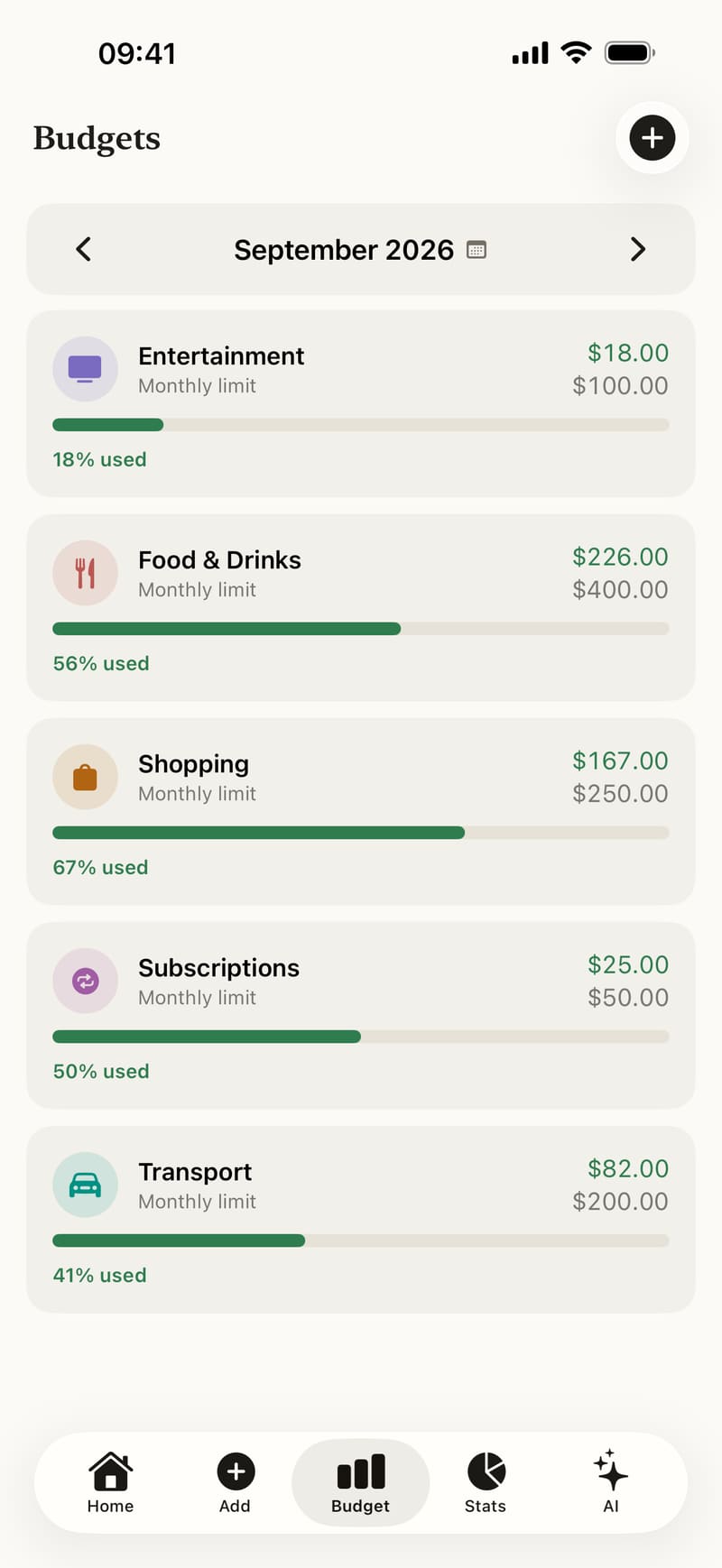
- Category limits. Give a category a monthly limit and follow its progress bar; Fince alerts you at 80% and 100%. The free version includes up to 10 budgets. See the monthly budgets guide.
- Savings first. A savings goal linked to your savings account shows how much to put aside each month to reach it by your date.
- Everyday spending. Left to spend per day on the dashboard divides what's left this month, upcoming bills included, by the days remaining.
- The review. The Stats tab shows the month's spending by category, so your end-of-month review starts from real numbers.
Adding an expense takes a few seconds: type "coffee 4.50" and Fince fills in the category and amount. Whatever tool you choose, the method stays the same: plan, note, review, adjust.