How much can I spend per day? A simple daily allowance
Take the money left for this month once your bills and savings are covered, divide it by the days left including today, and you have a daily allowance: one number to guide today's spending. Recalculate it as the month goes on. Spend less today and tomorrow's figure rises; spend more and it falls. Fince shows this figure on its dashboard as Left to spend per day.
"How much is in my account?" is a surprisingly unhelpful question. Your balance mixes money that's already promised (rent due next week, a phone bill, the amount you meant to save) with money you're actually free to spend. "How much can I spend today?" is a much better question, and it has a simple answer.
One number instead of ten
Category budgets are useful for planning, but they're hard to keep in your head at the checkout. A daily allowance compresses the whole month into a single figure you can remember: today, you have this much.
In France, a close idea goes by the name reste à vivre, literally "what's left to live on": the money left for everyday life once the fixed charges are paid. The phrase is used in several ways, and some banks and organizations give it their own definitions. Here we simply mean the everyday sense, divided by the days ahead.
How to work it out by hand
- Start with this month's income: what you've received, plus anything you're certain to receive before the month ends.
- Subtract what you've already spent this month.
- Subtract the bills still to come before the end of the month: rent if it hasn't gone out yet, phone, subscriptions, a loan payment.
- Subtract what you want to save this month, if you haven't moved it yet.
- Divide by the days left, including today.
Here's an example. It's the 12th of a 30-day month. You've received $2,800 this month and spent $1,450 so far, rent included. Still to come before the month ends: phone $45, internet $55 and a streaming subscription $15, so $115 in bills. You also want to keep $300 for savings.
- Money left: $2,800 − $1,450 − $115 − $300 = $935
- Days left, today included: 30 − 12 + 1 = 19
- Daily allowance: $935 ÷ 19 = $49.21, call it $49
Including today matters. The figure is meant to tell you what you can spend today, and on the last day of the month you still have one day to divide by, not zero.
Recalculate it as you go
The number isn't fixed for the month; it's a snapshot. Work it out again every day or every few days, and it corrects itself:
- Spend $30 today, and tomorrow's allowance is ($935 − $30) ÷ 18 = $50.28.
- Spend $120 today, and it's ($935 − $120) ÷ 18 = $45.28.
A cheap day is rewarded straight away. An expensive day doesn't wreck the budget; its cost is spread over the rest of the month, and you can see exactly how much it took from each remaining day.
Why a daily number works
- It's concrete. "$935 left" sounds like a lot on the 12th. "$49 today" is something you can hold up against a lunch or a grocery run in the moment.
- It paces the month. The familiar pattern of a comfortable first fortnight and a tight last week comes from spending a monthly total unevenly. A daily figure spreads it out.
- It gives permission, not just limits. If you've spent $15 of your $49, you know dinner out is fine, without guilt or mental arithmetic.
- It's forgiving. Going over isn't a failure that breaks the plan. It makes the next few days a little tighter, and you know by how much.
Its limits
- Large one-off purchases distort it. In the example above, a $600 flight bought today would leave ($935 − $600) ÷ 18 = $18.61 a day for the rest of the month. Big purchases are easier to plan separately, by setting money aside over several months.
- It's only as good as the bills you include. Forget a bill and the figure is too generous.
- It's a ceiling, not a target. You don't have to spend it. Whatever you don't spend raises the following days or ends up saved.
- It suits everyday spending. It doesn't replace knowing your fixed costs; it works best on top of a monthly budget that has already covered them.
How Fince does it automatically
Fince shows this figure on the dashboard as Left to spend per day. The calculation is: this month's income, minus this month's expenses, minus the recurring bills still due this month, plus the recurring income still expected, divided by the days left including today. Next to it you see the number of days left and the total left for the month, upcoming bills included.
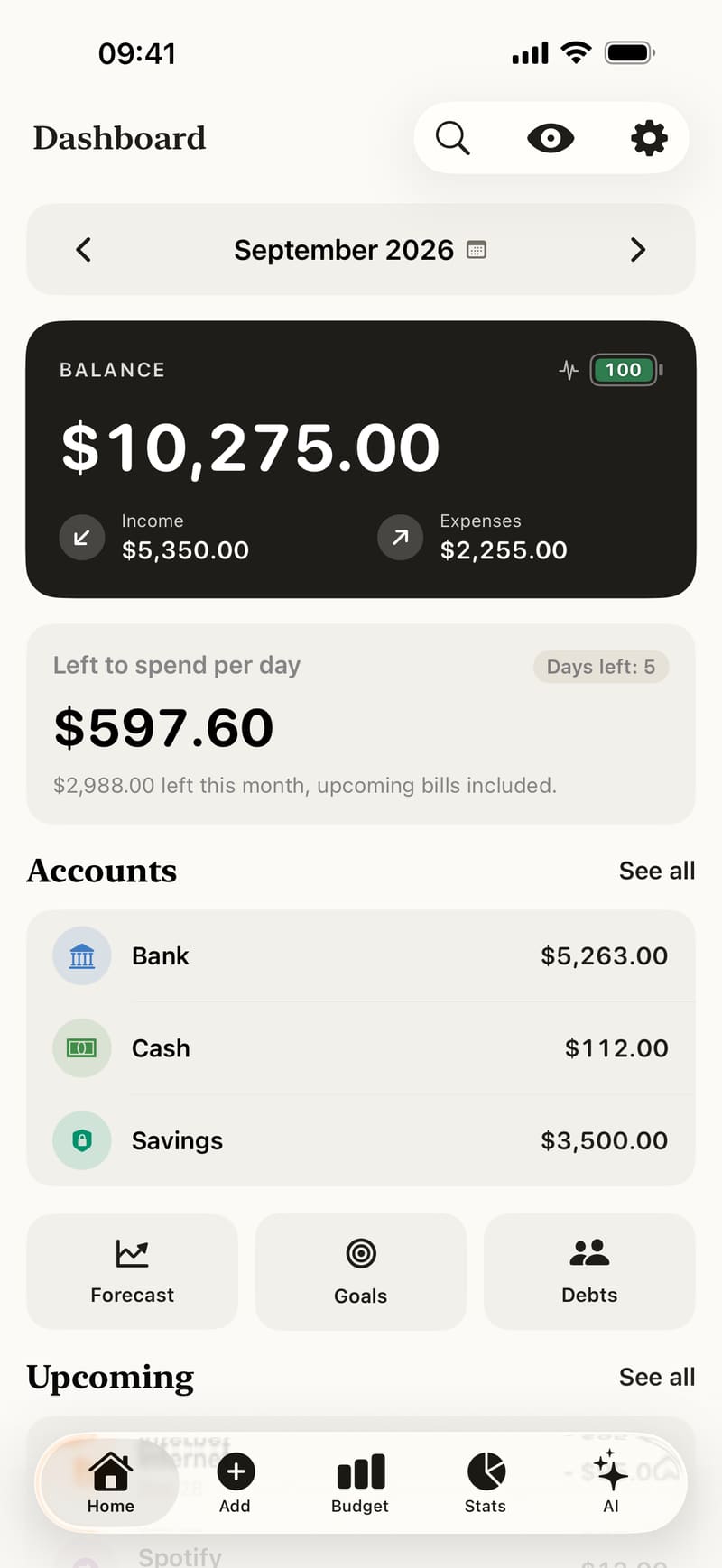
- It follows your bills. Add rent, subscriptions and your salary once as recurring items, and Fince counts the ones still due this month without you subtracting anything. The recurring bills guide shows how to set them up.
- It updates as you go. Each expense you add changes the figure, so it always reflects the month so far.
- It warns you when the month is over budget. If you've spent more than you received, upcoming bills included, the card reads Over for this month and shows the amount you're over in red.
- It covers the current month only, and appears once there is some income recorded or expected this month.
Savings work the same way as in the hand method, as long as they go to a savings account in Fince: money you move there this month is set aside and no longer counted as spendable. Once your $300 is transferred, Fince shows the same $49.21 a day. Until you move it, the card shows ($2,800 − $1,450 − $115) ÷ 19 = $65, because that money is still in your everyday account.
The Left to spend per day guide covers the card in detail. Whether you use an app or the back of an envelope, the habit is the same: one number, checked each day, so the end of the month holds no surprises.