The 50/30/20 rule explained, with a worked example
The 50/30/20 rule splits your take-home pay into three parts: 50% for needs, 30% for wants and 20% for savings and extra debt repayment. It's a quick way to check whether your spending is balanced, not a law. It struggles with high rent and with low or irregular income, so treat the numbers as a starting point and adjust the proportions to your life.
Most budgeting methods ask you to plan a dozen categories or more. The 50/30/20 rule asks for three. That's its appeal: you can check it on the back of an envelope, and it gives you a sense of balance without detailing every line.
What the rule says
Take your income after tax, the amount that actually reaches your account, and split it three ways:
- 50% for needs: what you must pay to live and work.
- 30% for wants: what makes life enjoyable but could be cut if you had to.
- 20% for savings and debt: money for your future self, including debt repayments beyond the minimum.
That's all. There's no list of approved categories and no fixed amount. The rule works in proportions, so it scales with whatever you earn.
Needs, wants, savings: what goes where
The split sounds obvious until you try to sort real expenses. Here's a reasonable way to draw the lines.
Needs include housing (rent or mortgage), energy and water, basic groceries, getting to work, insurance, health costs, childcare and the minimum payments on any debt. If skipping it would cause real trouble, it's a need.
Wants include eating out, takeaway, streaming and other subscriptions, holidays, hobbies, going out, clothes beyond the basics, and upgrades: the nicer phone, the bigger car, the premium plan.
Savings and debt covers money moved to savings, whether for a safety cushion or a longer-term project, and extra repayments that clear debt faster than the minimum.
Some expenses sit in between. A phone plan is a need; the most expensive plan is partly a want. Groceries are a need; the fancy cheese is a want. Don't agonize over each item. Decide once where a category belongs and stick to it, so that comparisons from one month to the next mean something.
A worked example
Say your take-home pay is $3,200 a month. The rule gives these targets:
- Needs: 50% of $3,200 = $1,600
- Wants: 30% of $3,200 = $960
- Savings and debt: 20% of $3,200 = $640
Now look at what actually happened last month. Needs came to $1,760: rent $1,150, energy and water $140, groceries $320, transport $90 and insurance $60. Wants came to $960, and $480 went to savings.
| Part | Target | Actual | Share of income |
|---|---|---|---|
| Needs | $1,600 | $1,760 | 55% |
| Wants | $960 | $960 | 30% |
| Savings and debt | $640 | $480 | 15% |
The picture is clear: wants are exactly on target, but rent pushes needs five points over, and savings end up five points short. The rule doesn't tell you what to do about it; it shows you where the tension is.
In this example, rent can't change quickly, so the lever is wants. Bringing them down to $800 (25%) frees $160, which lifts savings from $480 to $640, the full 20%. The result is a 55/25/20 split, and that's a perfectly sound budget.
Where the rule falls short
High rent
The rule assumes all your needs fit in half your income. If rent alone takes 40 or 45% of your take-home pay, as it can in expensive cities, 50% for every need is out of reach unless you move. The risk is feeling that you're failing at a target that was never realistic for your situation. Measure your real split honestly and work on the parts you can change.
Irregular income
50% of what? If you freelance, earn commission or work seasonally, your monthly figure can swing a lot. A practical approach is to apply the percentages to a cautious baseline, such as your lowest recent month, and send anything above that baseline to savings or a buffer once it has arrived. Our article on cash flow for freelancers goes further.
Low income, or high income
When money is tight, needs can take most of your income, and a 30% share for wants simply isn't there. Saving 20% may not be possible either; saving something regularly still counts. At the other end, if you earn well, 50% for needs may be more than you need, and 20% is a floor rather than a ceiling.
How to adapt it
- Measure before you set a target. Sort last month's spending into the three parts and work out your real split. That's your starting point, whatever it is.
- Change the proportions. Splits like 60/20/20 or 70/20/10 follow the same logic with different weights. What helps is having proportions you've chosen, not the particular numbers.
- Protect the savings share. Whatever the split, decide the savings amount first and move it when your income arrives, so it doesn't depend on what's left at the end of the month.
- Turn percentages into limits. A percentage only helps day to day once it becomes an amount per category. Our step-by-step guide to making a monthly budget shows how.
- Review every month. Check your real split at the end of each month and move towards your target one small change at a time.
How Fince helps you see your split
Fince doesn't have a 50/30/20 setting, and you don't need one to apply the rule. What it gives you is the raw material: where your money actually went.
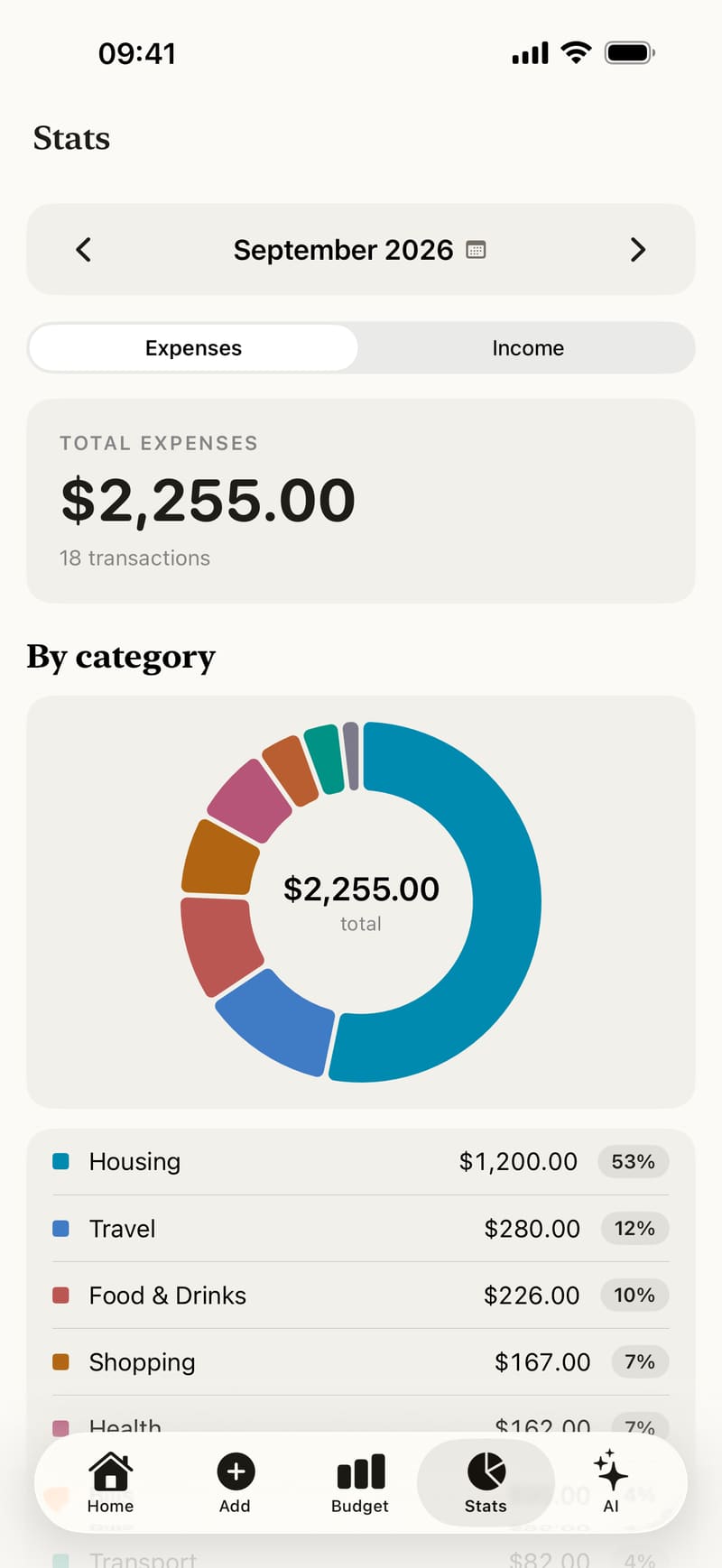
- Stats shows the month's spending by category in a donut chart, with each category's amount and percentage, and lets you switch between expenses and income. The percentages are shares of your spending, not of your income: to compare with the rule, divide each total by your take-home pay.
- Budgets turn your wants share into monthly limits on the categories where it goes, such as Entertainment, Shopping or Travel, with alerts at 80% and 100%. The monthly budgets guide explains how.
- Goals link a target to your savings account and show how much to put aside each month to reach it by your date (see the savings goals guide).
Everything stays on your iPhone, with no bank connection. You note what you spend, and after a month you can see your own split instead of guessing it.