Emergency fund: what it's for and how to build one
An emergency fund is money set aside for the unexpected: a lost income, a repair, a medical bill. A common guideline is a few months of essential expenses. You build it in small, regular steps, keep it apart from your everyday account but easy to reach, and only touch it for real emergencies.
What an emergency fund is for
An emergency fund is money you keep for the things you can't plan: the car breaks down, the heating stops, your income drops or stops for a while, you need to travel at short notice for family. Its job is simple. When one of these happens, you can pay for it without running up a card balance, going overdrawn or borrowing from someone you would rather not ask.
It is also what lets the rest of your budget hold. Without it, every surprise lands on the current month and knocks the plan off course. With it, a surprise is an inconvenience rather than a crisis.
What it is not: a holiday fund, a new-phone fund or a deposit for a home. Those are good goals with their own savings. Mixing them in makes it too easy to spend the safety net on something you had planned all along.
How big should it be?
A common rule of thumb is a few months of essential expenses, often put as three to six months. It is a general guideline, not a rule that fits everyone. Someone with a steady job and low fixed costs may feel comfortable near the lower end; someone with an irregular income, people who depend on them or a single income for the household may want more. Your own situation decides, not a formula, and if you are unsure, a qualified adviser can help you look at it.
Notice the word essential. You are not trying to fund your whole current lifestyle, only what you would need to keep going: housing, utilities, food, transport, insurance and minimum debt payments. That number is lower than your total monthly spending, which makes the target more reachable than it first looks.
A worked example
Say your essential expenses look like this:
| Essential expense | Per month |
|---|---|
| Rent | $1,100 |
| Utilities and phone | $150 |
| Groceries | $350 |
| Transport | $120 |
| Insurance | $80 |
| Total | $1,800 |
Three months of essentials is 3 × $1,800 = $5,400, so that is the target in this example. Putting aside $300 a month, it takes 18 months to get there ($5,400 ÷ $300 = 18). At $450 a month, it takes 12.
A year or more can feel like a long time. That is why it helps to break the target into milestones, and to count every step as progress.
Build it step by step
- Aim for a first small milestone. For example $1,000, or one month of essentials. It already takes the sting out of a surprise repair, and reaching it quickly shows you that the rest is doable.
- Pick a regular amount you can keep up. A modest amount every month beats an ambitious one you stop after two. Your monthly budget shows what fits.
- Move it on payday. Transfer the amount as soon as your income arrives, before the month starts spending it. If your bank lets you schedule a regular transfer, set it once and let it run.
- Add part of any windfall. A tax refund, a bonus, a gift, money from something you sold: putting some of it in the fund speeds things up without touching your monthly plan.
- Refill after you use it. Spending the fund on a real emergency is a success, not a failure. Afterwards, go back to the regular amount until it is full again.
Cutting a cost is another way to find the monthly amount. What you free up by cancelling a subscription you no longer use can go straight to the fund; see how to find and cut your subscriptions.
Where to keep it
Two things matter most:
- Separate from your everyday account. If the fund sits next to your spending money, it slowly becomes spending money. A separate account, with its own name, draws a clear line.
- Easy to reach. Emergencies don't wait. The money should be available quickly, without penalties and without depending on how the markets are doing that week.
Which kind of account fits best depends on where you live, your bank and your situation, so compare the options available to you, and ask a qualified adviser if you are unsure. Fince does not recommend any particular bank or product.
When to use it
A simple test before you dip in: is it necessary, is it urgent, and was it unexpected? A repair that keeps you getting to work passes. A sale on something you wanted doesn't. Yearly costs you can see coming, like a car service or an insurance renewal, are better handled with their own small monthly savings, so the emergency fund stays for real emergencies.
How Fince tracks it
In Fince, an emergency fund is a savings goal linked to a savings account. You add a savings account, then create a goal with a target (say $5,400) and, if you like, a deadline. The goal's progress is that account's balance: each time you record a transfer from your everyday account to the savings account, the bar moves. With a deadline, Fince shows how much to put aside per month to reach the target on time. If you already have some savings, enter them as the account's starting balance and the goal starts from there.
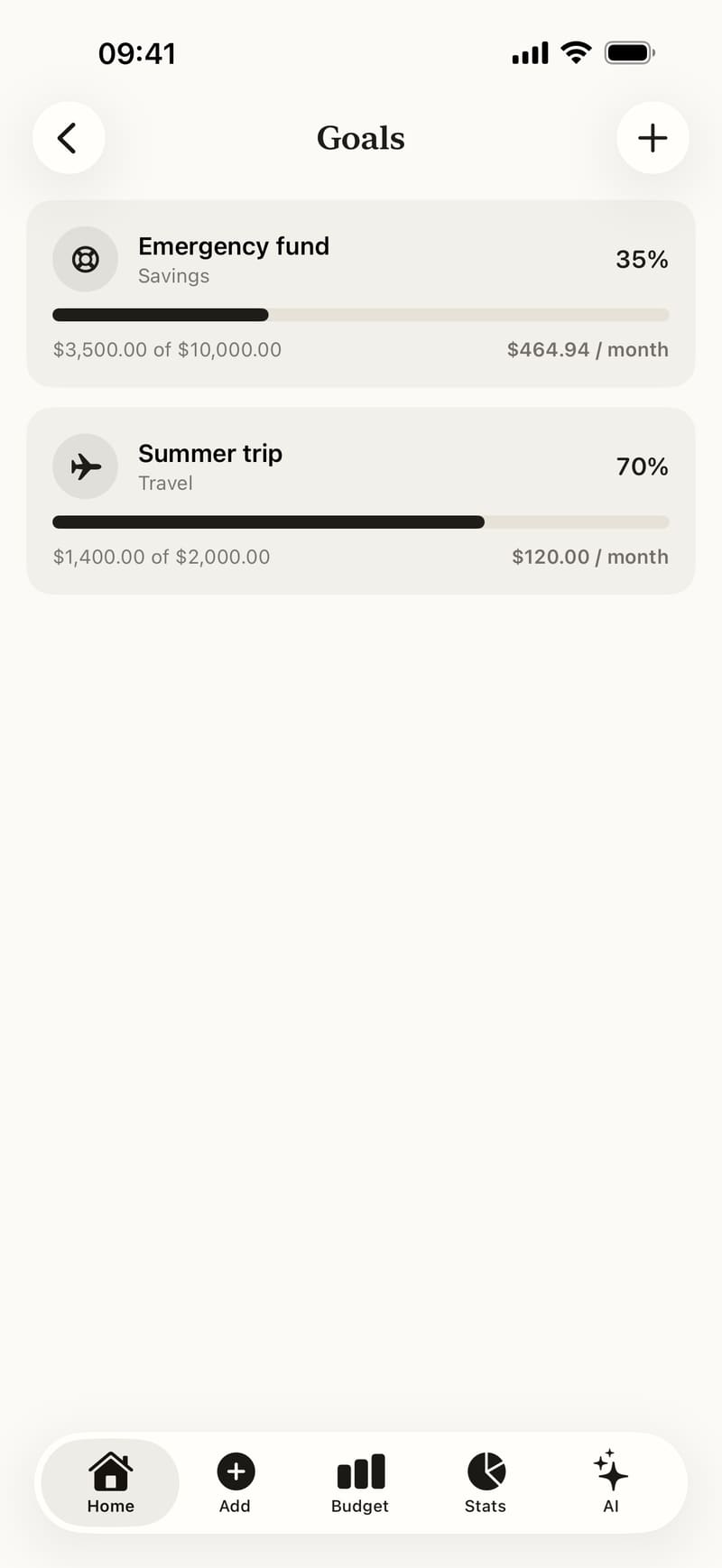
Fince does not connect to your bank, so the savings account in the app follows your real one through the transfers you record. The savings goals guide walks through the setup, and accounts and transfers explains how to move money between accounts in the app.